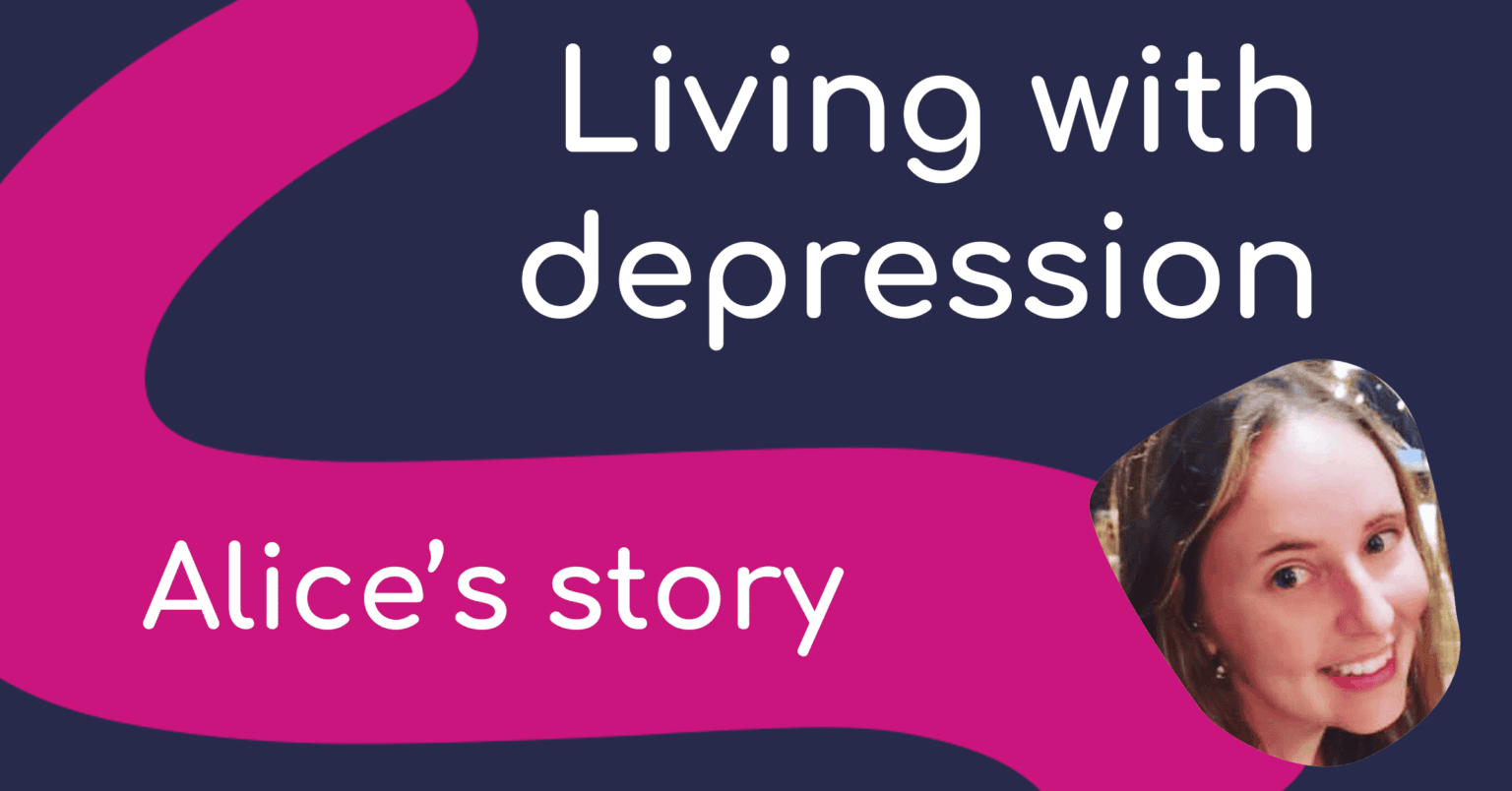
Alice talks openly about growing up with undiagnosed depression, getting her diagnosis at university, finding treatment that works, and developing the self‑care strategies that now help her stay well.
‘I thought I was “normal”, and everyone was having these same feelings and experiencing the same level of anxiety and self-confidence issues.’
I don’t think I’ve ever been particularly well. I was painfully shy in school – I was very anxious, and I had very, very low self-esteem. Until I got diagnosed, my perception was that everyone felt that way.
I thought I was ‘normal’, and everyone was having these same feelings and experiencing the same level of anxiety and self-confidence issues. I thought they were better at overcoming everything, rather than thinking that they didn’t even have the thoughts I was having!
One of my big triggers, the thing that really made it obvious that I wasn’t well, was taking the contraceptive pill at maybe 15 or 16 because I was anaemic. It was supposed to help my iron content so that I had more energy, but I grew up in France – there wasn’t much awareness of mental health, so it wasn’t thought about when I started taking the medication. That’s when I got really low, but even before that, I wasn’t mentally well.
School and college
‘I felt like no-one understood what I was going through.’
I struggled a lot. I went to an amazing school – it was an international school, so I had a wide range of friends. But there was a lot of pressure (that I put on myself) to do well.
I didn’t think much of myself at all, so I would belittle myself a lot. I didn’t think I was worth anything. And I felt I was never the ‘pretty one’, which I took quite hard. Looking back now, I realise that that wasn’t true. But I thought everything about me was wrong.
My parents were fantastic, they were supportive – I was never put down for my feelings or what was going on – but they didn’t understand the level of my feelings. I felt like no one understood what I was going through.
It made it really tough, but I was still very privileged in my experience. It was a balance of feeling overwhelmed a lot of the time, but also being so grateful for the opportunities I had. But that might be me talking retrospectively – I don’t think I thought that at the time.
The breakthrough
‘Eventually, I did find a doctor who I saw regularly. She was lovely, she just took the time to listen.’
I still had no idea when I started university. I went to the doctor to talk about being on a contraceptive pill. I told them about my concerns about going back on a pill – the weight gain, the feeling of being so low, and being so uncomfortable in my body that I wanted to crawl out of it (which sometimes still happened, but not to the extent that it did while I’d been on the pill in France).
The doctor picked up on the fact that these feelings might have been part of taking the pill, but also asked me about how I was – I didn’t realise what was happening, but she recognised some signs of clinical depression. I didn’t believe it. I told her, ‘No, you’re wrong. Everyone thinks this way,’ partly because I hadn’t really learned much about mental health.
I came to terms with it quite quickly because I did a bit more research and I realised that she was spot on with a lot of what she was saying. I also had a really good mentor at the time through the university, and he was able to help me process a lot.
From then, I started taking antidepressant tablets. The first one was helpful, but not helpful enough. I went off it for a bit and tried to go back to the same doctor, but it was hard. I couldn’t always see the same doctor or someone that I felt comfortable talking to.
Eventually, I did find a doctor who I saw regularly. She was lovely, she just took the time to listen. You knew, going to her, that you’d have to wait a bit because she was like that with everyone, so she’d always be a bit late! She suggested another medication, and I’ve been on that since – so that’s seven years.
Life today
‘I work in a school, and I am providing a role to a lot of students that I wish was in my school when I was growing up.’
So since then, I’ve moved out to Thailand. I’ve been able to stay on the same medication and I see a counsellor every week. They’re a meditative psychotherapist, so it’s very much based on going into your body, seeing what’s coming up. It allows me to dive into what is forming my reactions. It’s something that I’ve gained a lot from.
I work in a school, and I am providing a role to a lot of students that I wish was in my school when I was growing up. I teach about mental health and feelings – how they can affect you and what to do. I also do one-to-one sessions with students who do have those persistent negative thoughts.
Overall, I don’t have downs the way I did. I’m not completely stable, though. I have to track my period because I know that on the days before, it’s as if I’m not on any medication. It helps that when I feel it coming, I can check my phone and go, ‘this is OK, we can get through this, we’ve been here every month. We know what’s going to happen.’
If I move back to the UK, I’d love to try and find a specialist who has more experience of PMS to see if I can get more information on it and make a more informed decision about all of the different medication options.
Staying well
‘Self-kindness is a really big thing for anyone going through these emotions. The self-hatred and the self-judgment and the self-critique can be massive. For me, trying to think about if I’d ever speak to anyone else that way is helpful. I talk to myself like a friend.’
When I find things difficult, I think, ‘what are my techniques to deal with this?’
I can’t be on social media before my period, because I spiral into feeling like I’m not being involved in stuff, which is not true – I have an amazing group of friends here.
I find meditation and mindfulness quite helpful, even though I’m not very good at doing it for myself! I teach it a lot to the students I work with, but I have to remind myself to try it.
Also, just being kinder to myself. Self-kindness is a really big thing for anyone going through these emotions. The self-hatred and the self-judgment and the self-criticism can be massive. For me, trying to think about if I’d ever speak to anyone else that way is helpful. I talk to myself like a friend.
The techniques that work best will be different for different people. For me, it’s like a safety rope or a harness. You might fall down, but you’ve got the stuff to pull yourself back up and save yourself. Saying that, it’s OK to have days where they don’t work or you don’t even try them because you’re so low.
Looking back
‘Now I see that the diagnosis doesn’t take away from me. It hasn’t taken away from anything I’ve done.’
When I first started taking medication, I didn’t feel grounded, and I didn’t have any forward drive. I wanted to get through uni, but I don’t think I had any goals. I wasn’t very caring to the people around me. I was doing things that weren’t healthy for me, and it took me a while to get out of that.
At first, I thought that people should be going out of their way to help me. I feel like that’s a natural reaction when you feel like you’ve been dealt a bad hand and you feel like you’re less than other people. In some ways, that held me back – I used it as an excuse to not flourish, whereas actually, it was me holding myself back.
In that period, I definitely thought I would never excel, but now I see that the diagnosis doesn’t take away from me. It hasn’t taken away from anything I’ve done. It makes me so empathetic – it makes me amazing with students in my role, which is what I love to do.
Best For You would like to thank Alice for sharing her story with us.
If you, or someone you know, might be suffering from depression you can learn what depression is, how it affects people, and what treatment and support can help on this website.
Text NATTER for help
Anyone can text ‘NATTER’ to 85258 to seek
help, wherever they are in the UK. It’s a free, anonymous service and available 24/7.
More about NATTER
Find support
Find trusted services that can support you when things feel overwhelming.