Not sure what CAMHS is?
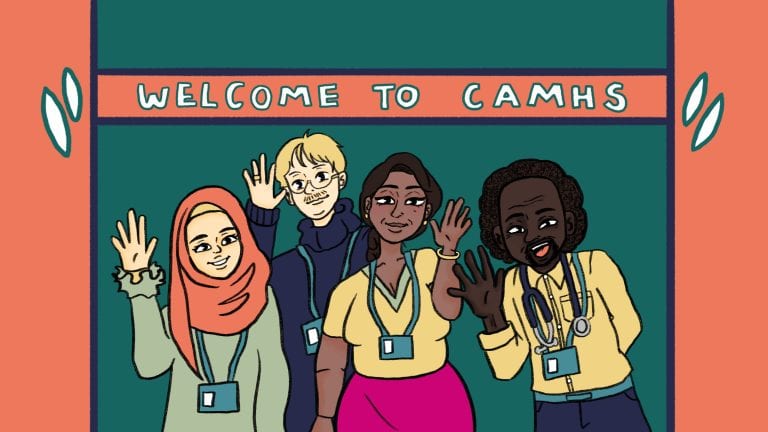
Find out more about Child and Adolescent Mental Health Services, including how they help people, who works there and how you get an appointment.
Jump to content on:
If you have an appointment with Child and Adolescent Mental Health Services (CAMHS) or are thinking about asking for help with your mental health, it’s understandable to have questions or to want to find out as much information as possible.
Who will know I’m going to CAMHS?
Like other NHS services, CAMHS have strict rules and won’t share information about you unless it’s necessary to help you or keep you safe. In most situations, you usually need to agree before CAMHS share your information.
It’s usually helpful for a parent or carer to know you are seeing CAMHS so they can support you.
If you are worried about your parents or carers knowing, you can talk to the person who refers you, or whoever you see at CAMHS. They will listen to your concerns and make sure you get the right help and support. Whether you can see CAMHS without a parent or carer knowing at all depends on things like the specific service’s rules and how old you are.
Usually, your school or college will only know you’re going to CAMHS if:
- You tell them.
- A parent or carer tells them.
- Someone at school made the referral to CAMHS for you in the first place.
- CAMHS have contacted them because they think it would be helpful for you to have more support at school. Most of the time, CAMHS will ask you first before contacting your school.
CAMHS may have to pass on information to other people if you say something that makes them worried about your safety (or the safety of someone else) to make sure you are kept safe. Usually, CAMHS will do their best to talk to you about this first.
Is what I say at CAMHS confidential?
If you have therapy sessions without your parents and carers in the room (or on the call), CAMHS do not usually tell them all of the details. Your therapist might ask you if they can share a little bit of information with a parent or carer if they think would help them to understand or support you better.
If you share anything that means someone at CAMHS is worried about your safety (or the safety of someone else) they may need to tell your parents or carers to make sure you are kept safe. Usually, CAMHS will do their best to talk to you about this first.
Will CAMHS send me to hospital?
Most people who see CAMHS see them as an outpatient, which means they travel to an appointment and then go home again (like when you go to school, or visit the GP or dentist).
Lots of young people are scared that CAMHS might send them to hospital, but it’s very rare.
CAMHS do not send every young person who has self-harmed to stay in hospital, for example. Young people only need to stay in hospital if they are very unwell, and it cannot be made safe for them to be at home.
‘From my experience, a lot of young people worry about something extreme happening to them. People are not immediately going to send you to a mental health hospital if you talk about self-harm – there are a lot of things we can do to help outside of hospital, including in CAMHS.’
Lucy, Mental Health Nurse
Will CAMHS diagnose me?
CAMHS can diagnose people with a mental health condition, but this does not always happen.
You don’t need a diagnosis to get help and support, and sometimes it’s more important for CAMHS to spend time helping you cope with whatever is going on for you right now.
Some conditions can also take a long time to understand and diagnose, and some are more difficult to diagnose in young people (compared to diagnosing them in adults).
It’s OK to ask the person (or people) you see at CAMHS about diagnosis, including talking to them about how you describe your mental health struggles and whether having (or not having) a diagnosis will affect your life and the support you get in the future.
How will CAMHS help me?
CAMHS help young people in lots of different ways depending on what they’re struggling with.
Services support people who are neurodivergent and/or struggling with their mental health. What this support looks like will be different depending on the young person, what they’re struggling with, what their specific CAMHS offers, and what they find helpful.
It might involve talking to a mental health nurse, accessing therapy, or taking medication. CAMHS can also help young people plan how they’ll cope if they experience a crisis, or make a plan to prevent relapses.
CAMHS can tell people about other groups, offers, and activities in their local area that they might find helpful.
Do I have to go to a CAMHS appointment – is it optional?
CAMHS are there to help young people who are struggling with their mental health. The people who work there want to support you and can talk about any concerns you have or work with you to make CAMHS more accessible.
It’s OK to ask questions, to explain that there are things that it’s hard to talk about, or to share things you’ve heard about CAMHS that make you feel worried. This helps the people who work at CAMHS to understand what’s going on for you and allows them to explain a bit more about CAMHS and how it can help.
Ultimately, no one can force you to go to a CAMHS appointment. But if you don’t go, people will often be even more worried about you. And going to a CAMHS appointment – even if it’s just to ask questions and see what it’s like – is often the first step to things getting better.
How long will I have to wait for a CAMHS appointment?
Almost everyone has to wait to see CAMHS, but exactly how long you have to wait will depend on your local service and their waiting lists. You can ask your local service about their waiting times.
‘Having made it through the waiting list and seen the people behind the “CAMHS” label, I can say there are people working tirelessly to try to reduce those waiting times.’Coping with being on the CAMHS waiting list

Who can I talk to if I’m unhappy with something that’s happened at CAMHS?
You can always talk to your therapist if you don’t think your treatment is working, or if you’re not finding it helpful. They might be able to work with you to make some changes, for example, by setting different goals or adjusting how you do something in your sessions.
Sometimes, people don’t get on with the person they’re working with and want to have sessions with someone else – though you may need to wait for an appointment to become available.
If you don’t want to talk to your therapist about a problem you’re having at CAMHS, you can ask the administration or reception staff to help you. They can let you know who else you can speak to.
It can feel difficult to speak up if you’re not happy with something that’s happened at CAMHS. You can do it in writing with an email or a letter, if you find it hard to talk in-person or over the phone. People often find it helpful to ask a trusted adult (like a parent, carer, or teacher) to help them, or to get in touch with CAMHS for them.
What if talking to someone at CAMHS hasn’t helped to resolve the issue?
If talking to someone at CAMHS hasn’t helped to resolve the issue, you can make a complaint. You can ask anyone at CAMHS how to make a complaint, and they should tell you about the service’s policy.
CAMHS are run by NHS Trusts – NHS organisations that provide services for a local area. Each NHS Trust has a free service that helps people resolve concerns about their care. These services are often called PALS (patient advice and liaison service) or a feedback and complaints service.
Find support
Find trusted services that can support you when things feel overwhelming.
Text NATTER for help
Anyone can text ‘NATTER’ to 85258 to seek
help, wherever they are in the UK. It’s a free, anonymous service and available 24/7.
More about NATTER